
Data Center: The Physician Workday — One Chart Behind The Manifesto
Sunday's argument was philosophical. This is the data underneath it.
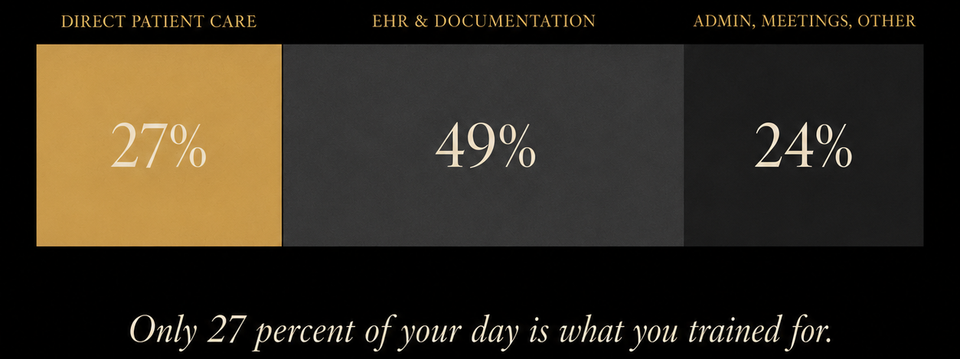
There is one study every physician should read before signing their next contract. It was published in the Annals of Internal Medicine in 2016. The authors followed physicians through their actual workdays, hour by hour, with stopwatches.
What they found is below.
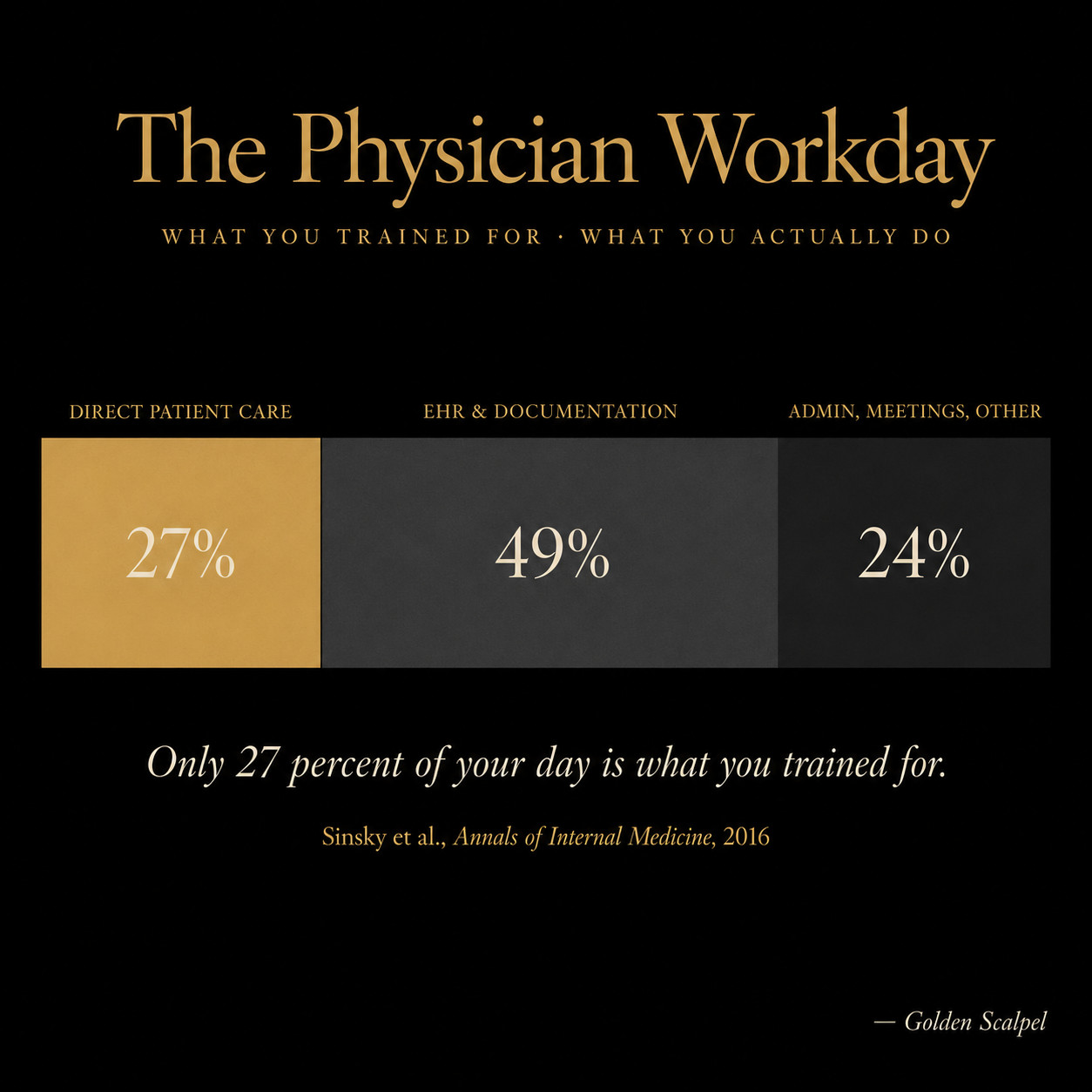
Twenty-seven percent.
That is the share of a physician's workday spent on direct patient care. The work physicians trained for. The work patients believe they are receiving when they make an appointment.
The remaining seventy-three percent is documentation, administrative tasks, billing review, meetings, and electronic health record work — much of it completed after the official workday has ended, in homes, after children have gone to bed.
This is not a personal failing. It is not a time management problem. It is not something a productivity app can fix.
It is the design.
The arrangement most physicians inherit was not built to maximize patient care. It was built to maximize documentation, billing capture, and institutional throughput. The physician is the data entry clerk who happens to also examine patients in the gaps.
The Manifesto did not argue that physicians are unhappy. It argued that the system was not built for them.
This is what that argument looks like, drawn at scale.
The Independent Physician Model is not a lifestyle preference. It is a structural response to a structural problem. Reclaiming the seventy-three percent — that is the work.
References & Methodology
The physician workday Sinsky CA, Colligan L, Li L, et al. Allocation of Physician Time in Ambulatory Practice: A Time and Motion Study in 4 Specialties. Annals of Internal Medicine. 2016;165(11):753-760. doi:10.7326/M16-0961
Subsequent confirmation in multiple specialties: Shanafelt TD, Dyrbye LN, West CP, et al. Relationship Between Clerical Burden and Characteristics of the Electronic Environment With Physician Burnout and Professional Satisfaction. Mayo Clinic Proceedings. 2016;91(7):836-848.
Figures are illustrative of structural patterns. Your specific workday may vary by specialty, practice model, and EHR system. This is education, not legal or financial advice.
THE VAULT holds 12 tools for paid subscribers.
Built for residents who are about to make decisions that will follow them for a decade — and for attendings who wish someone had given them this at the start
FREE TOOLS
Four tools. No email. No catch. Run your numbers and keep them.
Built by a surgeon who wished these existed during training.
The W-2 True Cost Calculator

What is your real hourly rate? Most doctors are surprised. Enter your salary, your hours, your weeks. The answer will bother you.
The Work Optional Timeline Calculator

Enter what you have, what you save, and what you spend. The tool returns the year work becomes optional. One number. Yours.
The Five Dials Diagnostic

Five dimensions. Twenty questions. One archetype. Know where you actually stand before you decide where to go.
FREE REFERENCE
The IPM Glossary

21 terms physicians need to know — contract language, business vocabulary, the framework. One page. Built because nobody handed us this at the start.
Work optional. Life intentional.
— Golden Scalpel

Nothing here is financial, legal, or medical advice. Golden Scalpel is an independent media publication. Always consult a qualified professional before making major decisions. This is perspective, not prescription.