
Resident Corner: Before You Sign — The Resident Contract Decision Tree

Residency teaches you to read EKGs. To recognize sepsis at 3 AM. To run an algorithm under pressure when a patient is crashing.
It does not teach you to read your first contract.
You will graduate, receive an offer letter, and have somewhere between two and six weeks to evaluate the most consequential document of your professional life. Most residents sign it within seventy-two hours. Most do not negotiate. Most do not know what they are looking at.
Below is the decision tree we wish someone had handed us at the start of fourth year. It is not legal advice. It is the algorithm — the same way you would run a workup on a patient with chest pain. Five questions. Each question has branches. Each branch has consequences.
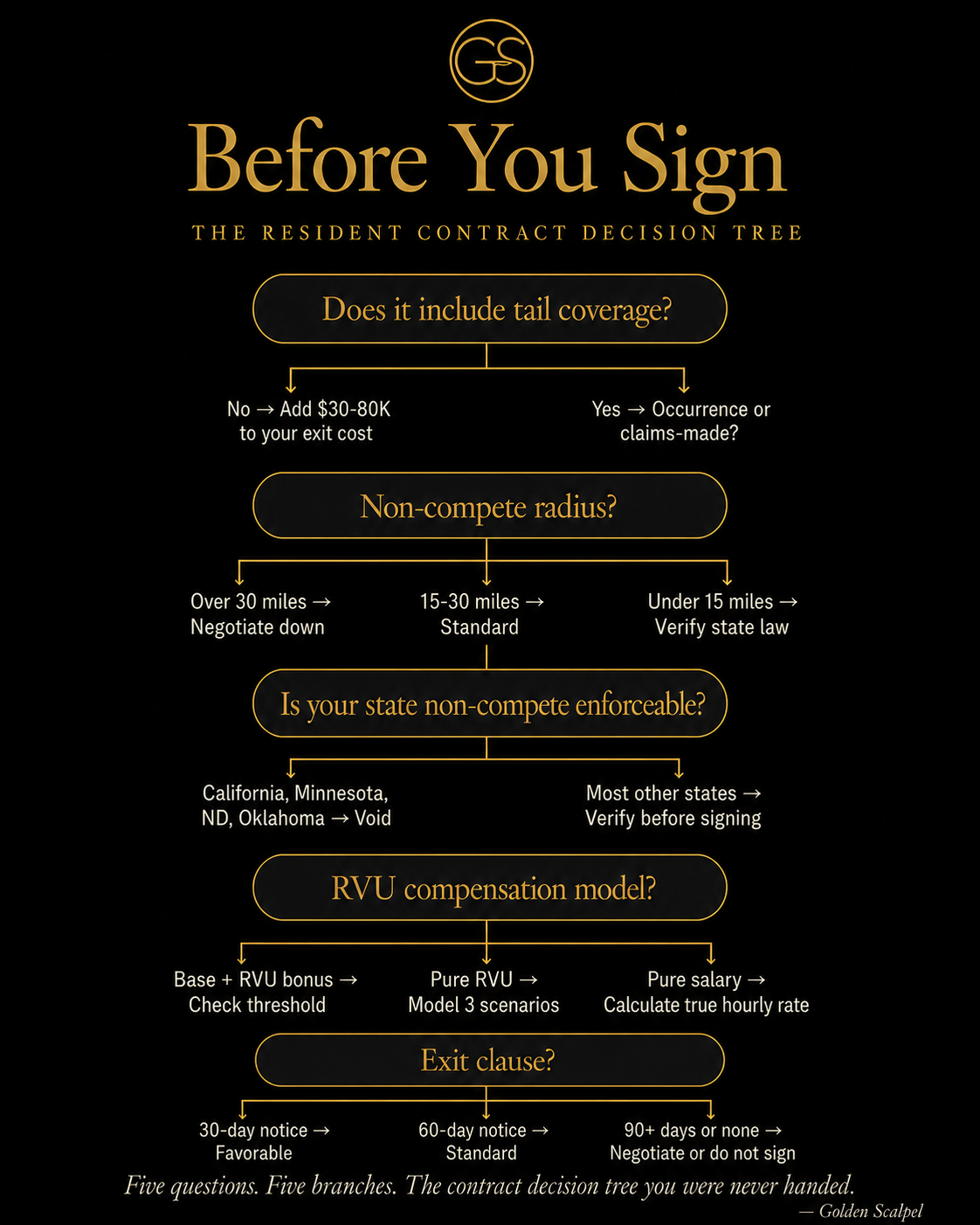
Node 1 — Tail coverage.
If you leave the job, who pays for malpractice claims filed after you are gone? Most claims-made policies require a tail policy on exit. Tail policies cost $30,000 to $80,000 for the average physician — sometimes more. If your contract does not specify who pays, you do.
Ask. Get it in writing. If they will not commit, model that cost into your exit math.
Node 2 — Non-compete radius.
The radius is the geography you are locked out of after you leave. Standard is 15 to 30 miles for two years. Anything over 30 miles is aggressive. Anything under 15 miles, if your state enforces them, is usually reasonable.
The radius compounds with hospital density. A 30-mile radius in rural Idaho is a different thing than a 30-mile radius in metropolitan Boston. Look at a map before you sign. Most physicians do not.
Node 3 — State enforceability.
This is where most residents stop the analysis when they should be starting it. Non-compete clauses are governed by state law, not federal law. California, Minnesota, North Dakota, and Oklahoma generally void physician non-competes entirely. Most other states enforce them if the terms are reasonable.
Before signing anything, look up your state's current non-compete enforceability for physicians. The Federal Trade Commission has been litigating broader changes. The legal landscape is shifting. Verify what your state's law says today, not what it said three years ago.
Node 4 — RVU compensation model.
There are three common structures:
Base salary with an RVU bonus is the most common. The question is not whether the bonus exists. The question is whether the threshold to earn it is achievable based on the panel size and patient mix the practice can actually deliver.
Pure RVU compensation pays you for what you produce. High ceiling, high floor uncertainty. Model your income across three scenarios: pessimistic, expected, and optimistic. If the pessimistic scenario does not cover your fixed costs, the contract is a gamble disguised as a salary.
Pure salary is the simplest model and often the most deceptive. Calculate the true hourly rate — salary divided by every working hour, including charting, call, committee work, and uncompensated documentation. The number that emerges is what you are actually being paid.
Node 5 — Exit clause.
How much notice are you required to give to leave? A 30-day notice clause is favorable. Sixty days is standard. Ninety days or more is unfavorable — it locks you into a position past most reasonable transition windows.
A contract with no exit clause is not a contract you can leave on your own terms. Do not sign without a clear, time-bound exit provision.
These five nodes will not catch every issue in a contract. They will catch the five that cost residents the most.
The first contract you sign sets the trajectory for the next three to five years. The non-compete radius restricts your geography. The tail liability shapes your exit math. The compensation structure determines how every clinical hour translates into actual income. The exit clause defines whether you can leave when the time comes.
Run the tree. If any node returns an answer you cannot defend, negotiate. If the employer will not negotiate, that itself is information.
References & Methodology
Tail coverage and contract structure American Medical Association Physician Employment Contract Toolkit, 2024. Standard tail premium estimates derived from MedPro Group and The Doctors Company industry data.
Non-compete state enforceability State-by-state non-compete enforceability variation summarized from American Bar Association employment law section reports and Federal Trade Commission Non-Compete Clause Rule proceedings (status varies).
RVU compensation modeling MGMA Provider Compensation Survey 2024. Range of compensation structures across employed and contracted physician populations.
This is educational content. It is not legal advice. Have an attorney licensed in your state review any employment contract before signing.
THE VAULT holds 12 tools for paid subscribers.
Built for residents who are about to make decisions that will follow them for a decade — and for attendings who wish someone had given them this at the start
FREE TOOLS
Four tools. No email. No catch. Run your numbers and keep them.
Built by a surgeon who wished these existed during training.
The W-2 True Cost Calculator

What is your real hourly rate? Most doctors are surprised. Enter your salary, your hours, your weeks. The answer will bother you.
The Work Optional Timeline Calculator

Enter what you have, what you save, and what you spend. The tool returns the year work becomes optional. One number. Yours.
The Five Dials Diagnostic

Five dimensions. Twenty questions. One archetype. Know where you actually stand before you decide where to go.
FREE REFERENCE
The IPM Glossary

21 terms physicians need to know — contract language, business vocabulary, the framework. One page. Built because nobody handed us this at the start.
Work optional. Life intentional.
— Golden Scalpel

Nothing here is financial, legal, or medical advice. Golden Scalpel is an independent media publication. Always consult a qualified professional before making major decisions. This is perspective, not prescription.